

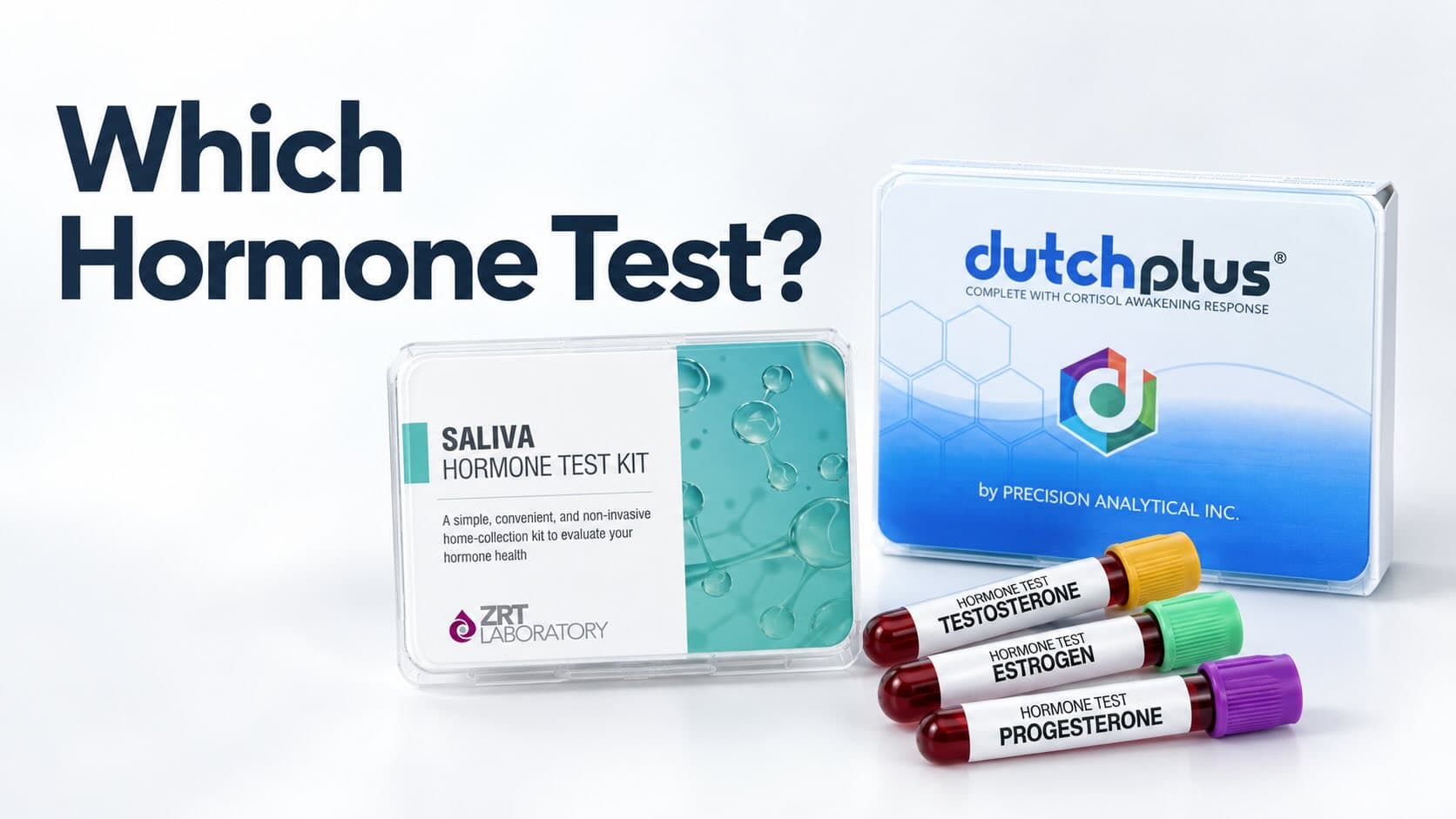
There's no such thing as "a hormone test." There are four, and they don't all look in the same place.
A blood draw from your arm, a saliva tube, a urine sample, and a finger-prick each read a different compartment the hormone can be in. Which one tells the truth depends mostly on one thing: how the hormone got into you. Made by your own ovaries, swallowed as a pill, or rubbed on as a cream. Get that match right and the numbers make sense. Get it wrong and a woman can be doing everything right and still get a result that says nothing is there.
Think of it like a package. If the delivery went to the back porch and you keep checking the mailbox, the package didn't fail to arrive. You looked in the wrong spot.
That's the whole article, honestly. The rest is the why, and what to do about it.
A blood draw sees the hormones your body makes
A tube from the vein in your arm is the standard, and for good reason. For the hormones your body makes on its own, and for anything you take that rides through the bloodstream (a pill, a shot, a pellet), a blood draw is the right tool. It's what a standard panel uses, and it does that job well.
Two things are worth knowing about it. First, it mostly reads the total hormone. Most of the hormone in your blood is bound to a carrier protein, riding around on hold. Only a small fraction is free to do anything. Money in the account, not money in your pocket. Second, one draw is a photograph. Hormones pulse through the day, and in perimenopause they swing from week to week. A single morning tells you where you were at 8:40 that morning.
A saliva test is built for hormone creams
This is the part that almost never gets explained, and it's the reason so many women on a cream get told it "isn't absorbing."
A cream goes into your skin and the tissue underneath it, and it mostly skips the trip through the bloodstream. It shows up in saliva, where the free hormone leaks out of tiny vessels into the gland. It shows up in a finger-prick, which is blood at the tissue's edge. It barely shows up in a tube drawn from the vein in your arm. In a randomized cross-over study of women using topical progesterone, saliva and capillary blood rose many-fold while the venous blood level barely moved [1].
So the blood test isn't wrong. It's checking the mailbox.
Saliva reads closer to the free hormone, the money in your pocket, which is why a saliva panel is a common way to monitor a cream. A finger-prick does a similar job from the blood side.
A urine test reads how you break estrogen down
Urine is a third thing again. It doesn't read the hormone. It reads what your body did with it: the breakdown products, and the routes your body used to make them. That's a genuinely different question, and a useful one, especially for women whose estrogen seems to linger or who want to know how their body is handling it. Dried-urine methods make it a kit you do at home [2].
What urine doesn't do is set a dose. It's the seasoning check after the dish is basically right, not the oven setting.
The route decides the test
Put those together and you get a rule you can carry around:
- Your own hormones, a pill, a shot, a pellet: blood.
- A cream: saliva, or a finger-prick.
- "How is my body handling estrogen?": urine.
And a second rule underneath it: pick the test you'll repeat. Weigh yourself on the bathroom scale Monday and the doctor's scale Friday and you've learned nothing about whether you changed. The first test is a snapshot. The second one, on the same instrument, is what tells you which direction you're moving. After a change, the first check-in is usually a few weeks out, and the retest that means something is around ninety days, because that's about how long hormones take to settle into a new pattern.
Where you put a cream matters too. Same woman, same dose, three sites, three different results [3]. A small area, rubbed in for a couple of minutes, is the whole trick.
What a standard panel checks, and what we look at
A standard blood panel checks the basics, and the basics matter. It's the right first look for the hormones your body makes, and it catches a lot.
What a fuller look adds is the match to the route and the follow-up on the same test. At Kitch Pharmacy in Lubbock, hormone testing is part of our advanced lab testing and functional medicine work: we run hormone panels in saliva, dried urine, and blood, and we read them alongside what you're actually feeling. Symptoms count as data the whole way through. When the picture points somewhere, that's a conversation with your prescriber about a personalized plan, sometimes a compounded one. Compounded hormones are made for an individual on a prescriber's order; they aren't FDA-approved products, and we'll always say so.
Where the experts disagree
This is the part most articles skip, and it's the part worth trusting.
There's more than one good way to test hormones, and the people who study this disagree at the edges. Some argue saliva is the best monitor for a cream because blood can't see it. Others argue a hormone diffuses into a salivary gland far more easily than into brain tissue, so a fine saliva number can coexist with a brain getting too little, and dosing to saliva alone risks underdosing. Both positions are argued from mechanism. Neither is settled.
Urine has the same shape of disagreement: one camp uses it only to read breakdown, never to set a dose; another uses it to fine-tune once symptoms are settled. And "which test first" is a protocol, not a law. Different clinicians start in different places for good reasons.
What survives all of that: the route decides the test, one draw is a snapshot, symptoms are data, and the retest on the same instrument is where the information lives.
What to do next
- Write down how you take your hormones, if you take any. Pill, cream, patch, pellet, or none.
- Bring your last hormone results, whatever kind they were. Nothing is wasted; it's a first photo.
- Come talk to us. We'll match the test to the route, pick the one we'll repeat, and read it with you.
Kitch Pharmacy is at 10501 Quaker Ave, Suite 300, in Lubbock. Stop by or give us a call at 806-370-7311.
Common questions
My blood test says my hormone cream isn't working. Is it?
It might be working fine. A cream goes into skin and tissue and barely registers in a venous blood draw, even when saliva and finger-prick levels have risen. The blood test isn't wrong; it's reading a different compartment. Ask about a saliva or finger-prick panel.
Is a saliva test more accurate than a blood test?
Neither is "more accurate." They read different places. Blood is the right tool for the hormones your body makes and for pills, shots, and pellets. Saliva is a common tool for creams. The experts disagree at the edges about which to trust when, and symptoms count as data alongside either.
What does a urine hormone test show?
How your body is breaking estrogen down, including which of its routes it's using. It doesn't measure the hormone itself and it isn't how a dose gets set.
How often should hormone levels be rechecked?
After a change, a check-in a few weeks out to see how you feel, and a retest around ninety days on the same kind of test. After that, every so often on the same instrument, so each result compares to the last one.
Does it matter where I put a hormone cream?
Yes. The same dose on different sites gives different results. A small area, rubbed in for about two minutes, is the standard advice. Your kit or your pharmacist will tell you where.
Can one hormone test tell me if I'm in menopause?
One number rarely settles it. In perimenopause hormones swing month to month, and the ranges for "menopausal" and "still cycling" overlap in real women. A pattern across time tells you more than one line on one day.
References
- Du JY, Sanchez P, Kim L, Azen CG, Zava DT, Stanczyk FZ. Percutaneous progesterone delivery via cream or gel application in postmenopausal women: a randomized cross-over study of progesterone levels in serum, whole blood, saliva, and capillary blood. Menopause. 2013;20(11):1169-75. PubMed · DOI
- Newman M, Pratt SM, Curran DA, et al. Evaluating urinary estrogen and progesterone metabolites using dried filter paper samples and GC-MS/MS. BMC Chemistry. 2019;13:20. PubMed · DOI
- Järvinen A, et al. Steady-state pharmacokinetics of oestradiol gel in post-menopausal women: effects of application area and washing. Br J Obstet Gynaecol. 1997;104(Suppl 16):14-18. PubMed · DOI
- Edelman A, Stouffer R, Zava D, Jensen J. Validation of blood spot sampling for gonadotropins and ovarian hormone levels in reproductive age women. Fertil Steril. 2007. PubMed · DOI
- Mendel CM. The free hormone hypothesis: a physiologically based mathematical model. Endocr Rev. 1989;10(3):232-74. PubMed · DOI
Kristine Isaacson, PharmD, is the owner and pharmacist-in-charge at Kitch Pharmacy, an independent compounding and functional-medicine pharmacy in Lubbock, Texas. This article is education, not medical advice; hormone decisions belong with you and your prescriber.